Core-collapse supernova γ-ray signatures
Radioactive isotopes, presolar grains, and the nuclear reactions that shape supernova observables
The science question
Which nuclear reactions control the radioactive isotopes that let us diagnose core-collapse supernovae?
Radioisotopes such as \(\mathrm{^{44}Ti}\), \(\mathrm{^{56}Ni}\), \(\mathrm{^{22}Na}\), \(\mathrm{^{43}K}\), \(\mathrm{^{47}Sc}\) and \(\mathrm{^{59}Fe}\) can connect the deep physics of an explosion to γ-ray observations, late-time light curves, and presolar grain signatures. The challenge is that the relevant reaction rates are often poorly constrained at stellar energies.
What we do
- Identify reactions that control \(\gamma\)-ray emitting isotopes in supernova models.
- Measure or constrain key reactions using radioactive-ion beams and indirect spectroscopy.
- Connect laboratory rates to predicted \(\gamma\)-ray fluxes, light curves, and isotopic signatures in stardust.
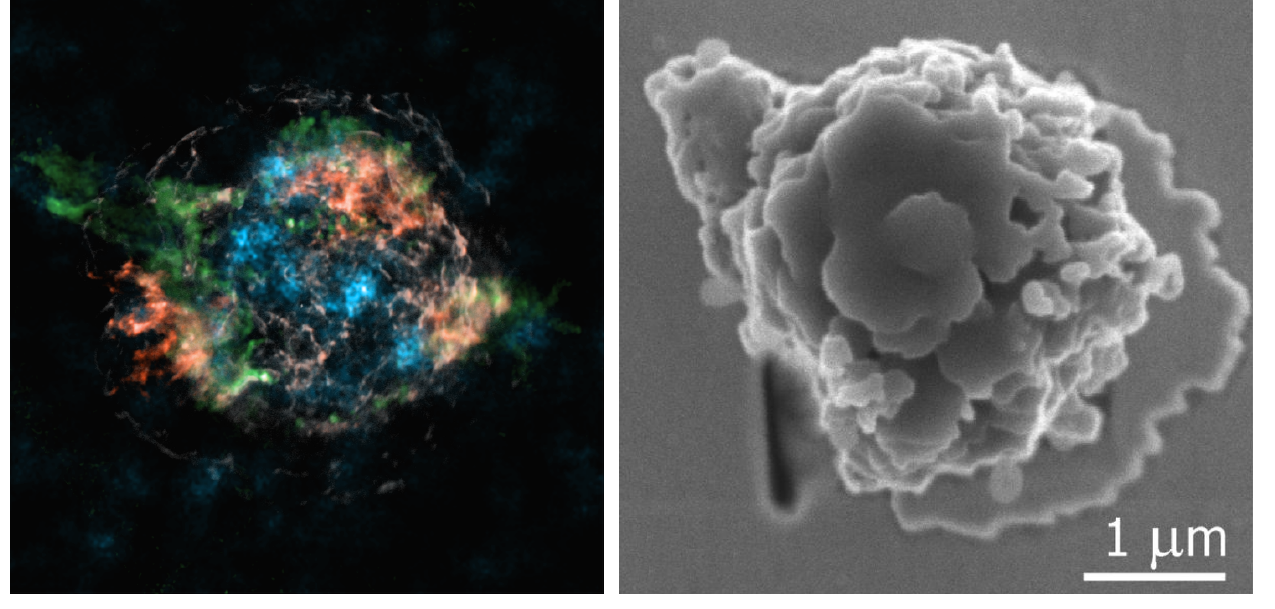
- Use supernova remnants and presolar grains as complementary tests of nucleosynthesis.
Student entry points
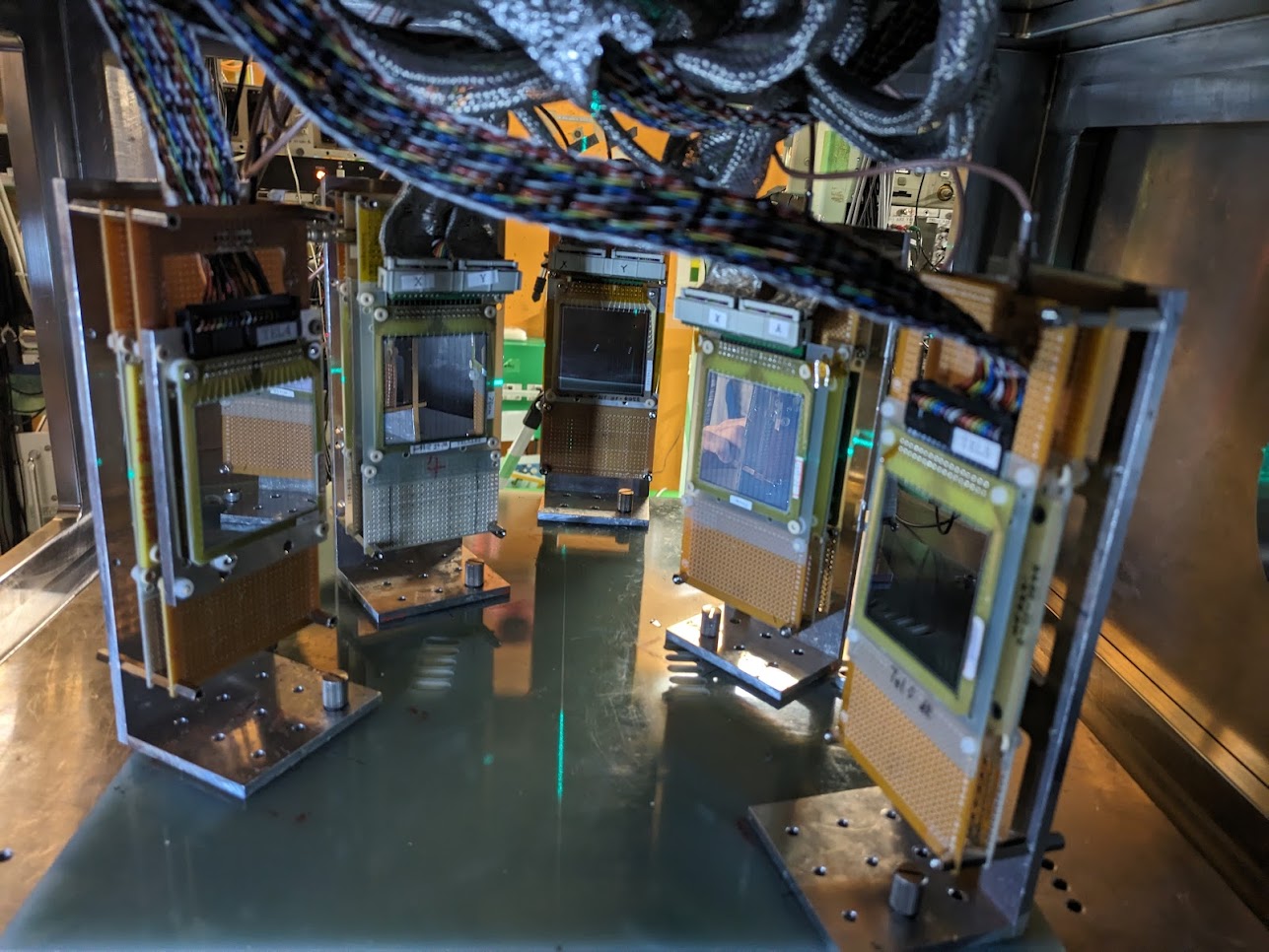
- Analyze reaction data and detector simulations from radioactive-beam experiments.
- Run sensitivity studies for radioactive isotope yields in supernova ejecta.
- Compare model yields with gamma-ray observables and presolar grain constraints.
- Build clear visual links between a nuclear reaction, a radioisotope, and an astronomical signature.
Selected output
M. Abubakar et al., Phys. Rev. C 113, L062802 (2026)
M. Pignatari et al., Astrophys. J. 990 (2025)
A. Psaltis, “Nuclear physics constraints on the γ-ray signatures of core-collapse supernovae”, IReNA Online Seminar (2026)