γ-process and the origin of p-nuclei
Experiments and models for the rarest of the heavy elements
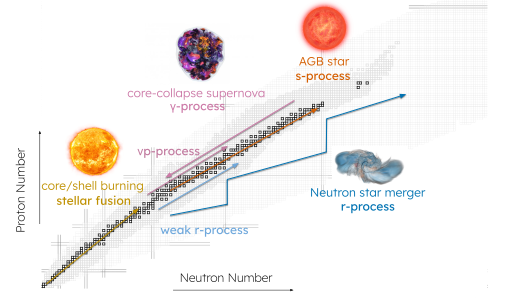
The question
How are the rare neutron-deficient isotopes beyond iron made, and why do some of them remain difficult to reproduce in stellar models?
The p-nuclei are only a small fraction of the heavy-isotope inventory, but they are a sharp test of explosive nucleosynthesis. Their production involves photodisintegration, proton capture, alpha capture, and neutrino-processed environments, so progress requires both better astrophysical models and better nuclear data.
What we do
- Measure proton-capture reactions that test statistical-model predictions near the γ-process energy window.
- Study reactions on radioactive nuclei with recoil separators and storage-ring techniques.
- Compare model yields with solar p-nuclei abundances and isotopic ratios.
- Identify where nuclear physics alone cannot solve an abundance discrepancy, pointing back to the astrophysical conditions.
Student entry points
- Compare measured cross sections with Hauser-Feshbach calculations.
- Explore sensitivity of p-nucleus production to uncertain rates.
- Work with published data from recoil separators, activation studies, or storage rings.
- Build explanatory figures for reaction flows around selected p-nuclei.
Selected output
A. Tsantiri et al., Phys. Rev. Lett. 135, 212701 (2025)
S. F. Dellmann et al., Phys. Rev. Lett. 134, 142701 (2025)
L. Roberti et al., Astron. Astrophys. (2023)
M. Williams et al., Phys. Rev. C 107, 035803 (2023)
A. Psaltis et al., Phys. Rev. C 99, 065807 (2019)