Rare isotope experiments for stellar explosions
Recoil separators, storage rings, active targets, and radioactive beams for nuclear astrophysics
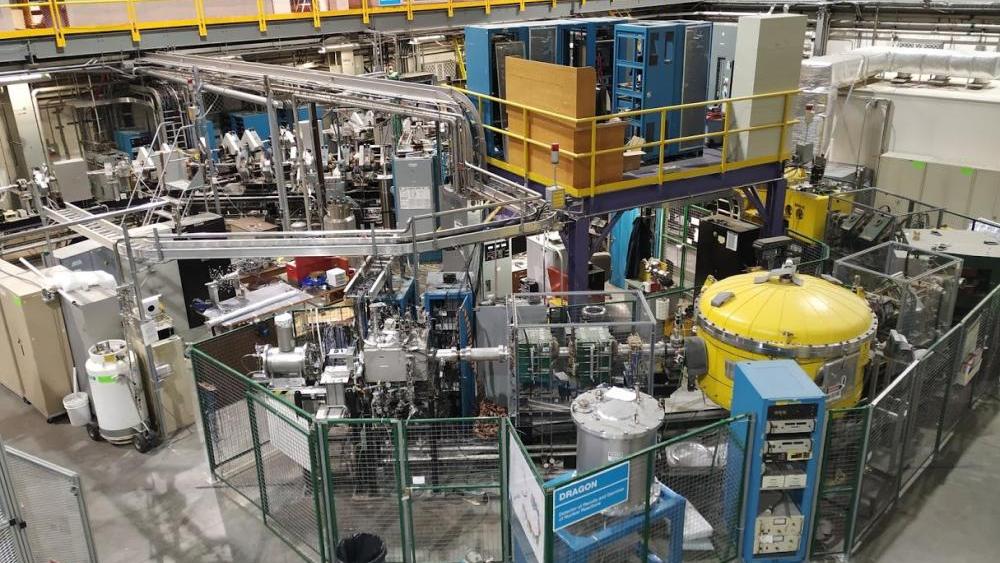
Recoil separators and radioactive beams make it possible to measure reactions that occur in explosive stellar environments.
The science question
How can we measure reactions involving short-lived nuclei when the relevant stellar energies are extremely low and the beams are difficult to produce?
Many of the reactions that shape stellar explosions involve radioactive nuclei. Measuring them requires specialized facilities, careful background suppression, and detectors designed around rare events.
What we do
- Use recoil separators, active targets, time projection chambers, storage rings, and charged-particle spectroscopy to constrain astrophysical reaction rates.
- Connect experimental observables such as resonance strengths, cross sections, and spectroscopic factors to reaction-rate evaluations.
- Work with international facilities including TRIUMF, RIKEN/CRIB, FRIB, GSI/FAIR, Argonne and others.
Student entry points
- Calibrate detector data and identify reaction products.
- Simulate experimental setups and efficiencies.
- Extract cross sections or resonance properties from measured yields.
- Translate experimental constraints into rates for astrophysical calculations.
Selected output
A. Psaltis et al., Nucl. Instrum. Methods Phys. Res. A 987, 164828 (2021)
H. Jayatissa et al., Phys. Rev. Lett. 131, 112701 (2023)
J. J. Marsh et al., Eur. Phys. J. A 60 (2024)
L. Varga et al., Phys. Rev. Lett. 134, 082701 (2025)