Reaction rates, networks, and uncertainty quantification
Turning nuclear measurements into predictive nucleosynthesis calculations
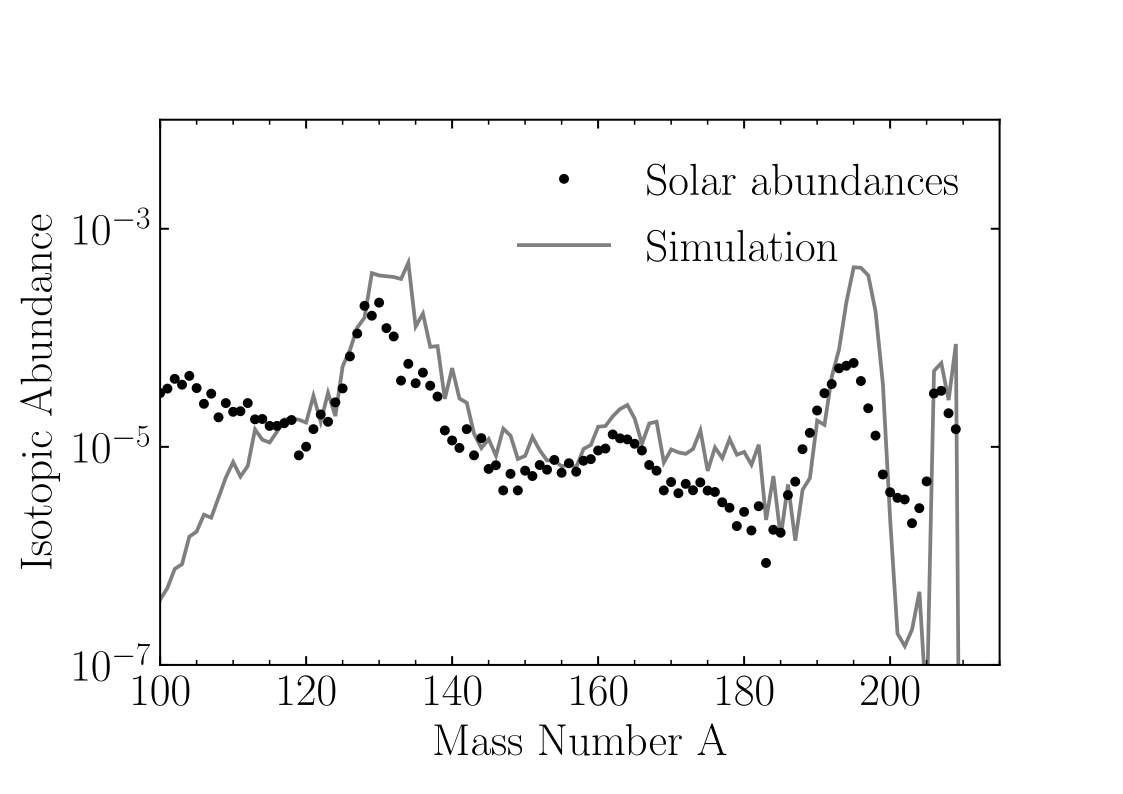
Reaction networks connect thousands of microscopic nuclear links to macroscopic stellar abundances.
The science question
How do we turn uncertain nuclear data into reliable predictions for the elements made in stars and stellar explosions?
Experiments rarely measure every piece of nuclear information needed by astrophysical models. Reaction-rate evaluations, uncertainty quantification, Bayesian analysis, and network calculations provide the bridge between laboratory data and abundance predictions.
What we do
- Evaluate thermonuclear reaction rates and their uncertainties from experimental nuclear data.
- Use Monte Carlo and Bayesian methods to propagate uncertainties into nucleosynthesis predictions.
- Identify the dominant sources of uncertainty at the temperatures relevant for novae, supernovae, and X-ray bursts.
- Build and test nuclear networks for explosive astrophysical environments.
Student entry points
- Write Python tools to sample reaction rates and analyze abundance distributions.
- Compare rate libraries and visualize uncertainty bands as a function of temperature.
- Use Bayesian methods to constrain model parameters from experimental data.
- Build compact networks that preserve the physics needed for hydrodynamic simulations.
Selected output
A. Psaltis et al., Astrophys. J. 935, 27 (2022)
C. Iliadis et al., Astrophys. J. Suppl. Ser. 283 (2026)
C. Marshall et al., Phys. Rev. C 112, 045801 (2025)
P. Mohr et al., At. Data Nucl. Data Tables 142, 101453 (2021)